

To help car shoppers compare vehicle types, the EPA has created the term “MPGe.” Here’s what it stands for, how it’s calculated and why it matters to you.
What Is MPGe?
Miles per gallon of gasoline-equivalent (MPGe) offers a standardized measurement for comparing the energy efficiency of EVs to traditional internal combustion engine (ICE) vehicles. It describes the distance an EV can travel using the energy equivalent to one gallon of gasoline. Essentially, MPGe helps car shoppers understand the efficiency of the electric cars they are researching. Don’t be surprised when you see how high the number goes, either. Electric vehicles really are that much more energy-efficient than those complex gas-guzzlers.
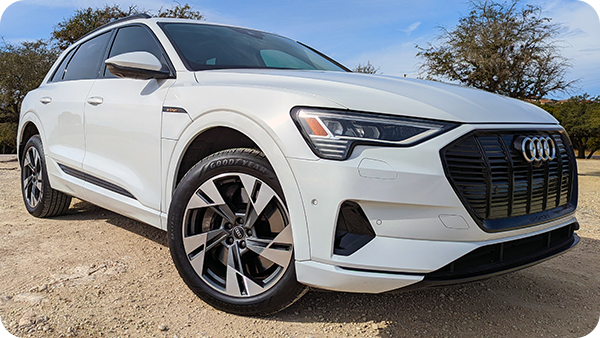
An Audi Q7 gets 20 MPG combined, while the similarly sized e-tron gets a whopping 79 MPGe.
How Is MPGe Calculated?
Just like with ICE vehicles, the EPA runs a series of tests in a lab on electric cars to determine how much energy in kilowatt-hours (kWh) they use at “highway” and “city” speeds to drive 100 miles. Some arithmetic is used to compare this to the standardized amount of energy in a gallon of gasoline, which is 33.7 kWh.
The math works like this:
MPGe = (Miles Traveled on Electricity) / (Energy Consumed in kWh) * (Energy Content of 1 Gallon of Gasoline in kWh)
Example:
- 2024 Rivian R1S uses 54 kWh to travel 100 miles (or roughly 1.6 gallons of gas).
- Applying the formula: MPGe = 100 miles / 54 kWh * 33.7 kWh/gallon = ~63 MPGe.
Electric car battery packs often have a capacity around 50-100 kWh. This means that there’s really only 1.5-3 gallons of gas equivalent worth of energy stored at once. This is enough energy to travel for 250-400 miles. That just goes to show how much more efficient electric vehicle drivetrains really are.

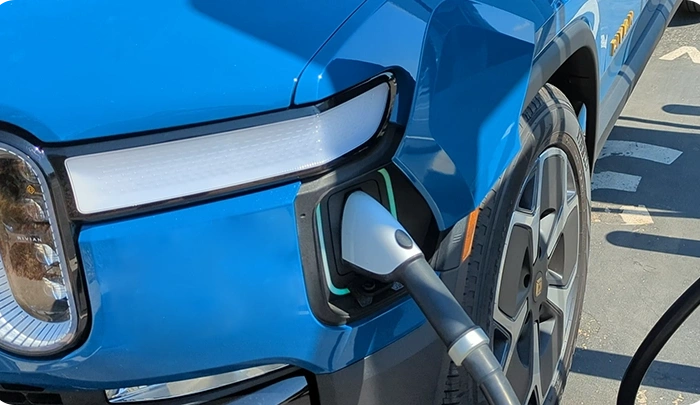
Even large and heavy EVs like my Rivian R1T, are still far more efficient than any gas or diesel-powered vehicles, including hybrids.
Highway vs City MPGe Ratings
You might notice that electric cars are more efficient in city driving than on the highway, which is the opposite of ICE vehicles. This is for two primary reasons. First, ICE engines still idle when you are stopped, but EVs use minimal electricity while idling. Second, electric vehicles have a feature called regenerative braking which, if activated, will slow the vehicle down automatically when you remove your foot from the accelerator, with the electric motors acting as generators. This returns some of that unused energy back into the battery pack.
EVs with the Highest Rated MPGe
According to the EPA, the highest rated MPGe EVs currently available in the United States (featuring base or aero wheels; one version per model) include:
- 2026 Lucid Air Pure RWD (19-inch wheels)
- 146 MPGe combined
- 2026 Tesla Model 3 RWD (18-inch wheels)
- 140 MPGe combined
- 2026 Tesla Model Y RWD (18-inch wheels)
- 140 MPGe combined
- 2026 Hyundai Ioniq 6 Long Range RWD
- 140 MPGe combined
- 2026 Toyota bZ XLE FWD Plus
- 131 MPGe combined

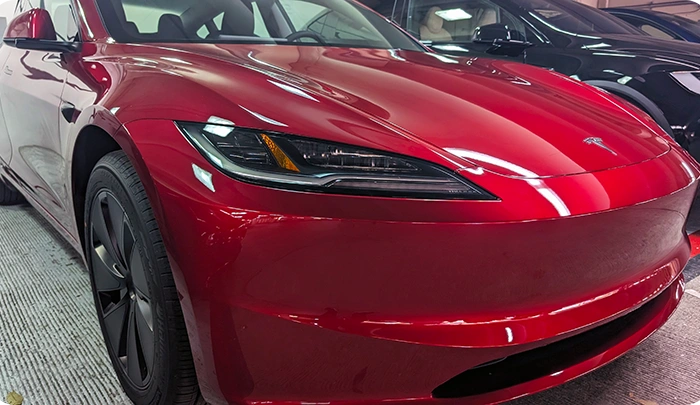
The Tesla Model 3 offers one of the highest combined MPGe ratings on the market today.
EVs With the Lowest MPGe
On the other end, here are the EVs with the lowest rated MPGe as tested by the EPA (only the lowest rated version of each model shown):
- 2026 GMC Hummer EV (22-inch wheels)
- 53 MPGe combined (59 city/48 highway), dropping to 50 MPGe with the mud-terrain tire package
- 2026 Chevrolet Silverado EV (Max Range 4WD)
- 68 MPGe combined
- 2026 Ford F-150 Lightning (Extended Range AWD)
- 70 MPGe combined
Other large electric trucks and SUVs, like the Cadillac Escalade IQ, GMC Sierra EV, and Tesla Cybertruck, all sit in this same bottom tier.
Why Does MPGe Matter?
MPGe tells you, in relative terms, how much you’re going to spend to charge up your car. If you are looking to reduce the amount of money it takes to own and operate an electric vehicle, then finding a model with the lowest initial price and highest MPGe rating is going to be the right strategy. Some of the most technologically advanced electric cars, like the Lucid Air, have ratings over 140 MPGe. However, this model starts around $70,000. On the flipside, you can buy a 2026 Nissan Leaf with a combined 120 MPGe for around $30,000.
Where to Find MPGe Ratings
Just like with ICE vehicles and MPG ratings, MPGe will be shown on the window (Monroney) sticker. You can also go to the EPA’s website and find the ratings there.

The window sticker with the MPGe ratings from my 2022 Tesla Model S.
Limitations of MPGe
Much like the EPA’s estimated MPG ratings, you should expect some discrepancy between what the window sticker says and real-world driving conditions. There are many things that can improve or drastically lower your EV’s efficiency. The worst culprit is cold weather, which can temporarily reduce your battery capacity, and increase energy loss due to functions like heating the cabin. The other causes of efficiency losses are often strong headwinds, driving at high speeds on the highway, and changing to larger wheels or thicker tires.

Doing some math, on this trip, my Rivian R1T was getting 99.2 MPGe versus the 70 MPGe it’s rated for.
However, the opposite can be true, too. If you drive the speed limit on the highway, have a nice tailwind at your back, and the weather is nice, you could beat your EPA-estimated range and MPGe by 10%, 20% or more. It’s best to look at MPGe as a ballpark figure and certainly not an absolute.
Tips for Getting the Most MPGe
Here are some things to keep in mind if maximizing MPGe is important to you.
- Order the smallest wheels and tires, as larger options have more rolling resistance and aren’t as efficient.
- Drive the speed limit, because as you drive faster, drag from the wind increases exponentially.
- If your EV offers a conserve or eco mode, use it unless you need the extra power.
- During the winter months or colder days, rely more on the heated seats and steering wheel and less on the HVAC system.
- Roll your car windows up and use the HVAC fan to bring fresh air into the cabin, otherwise, drag on the vehicle increases.
All in all, I recommend just enjoying your electric car by driving it the way that you want to and don’t waste much time worrying about small amounts of changes in MPGe day-to-day.
Sources
Related Articles