

As an electric car owner, you’ll want to know two terms: miles per kilowatt-hour (mi/kWh) and watt-hours per mile (Wh/mi). Here’s why.
What Miles Per Kilowatt-Hour Means
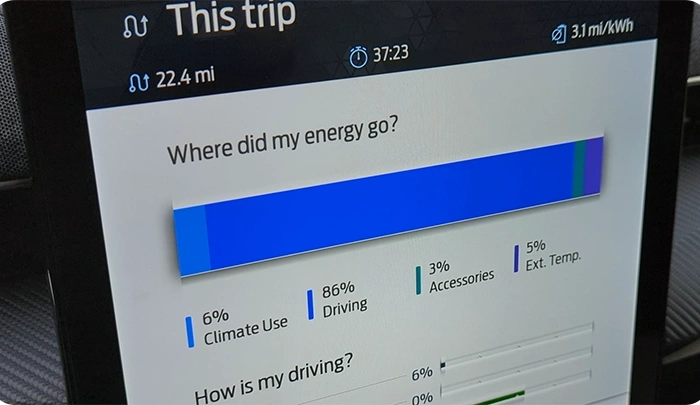
Miles per kilowatt-hour describes an electric car’s efficiency. Specifically, it measures how many miles an EV can drive for every kilowatt-hour of stored energy in its battery pack. Automakers use this metric to create the miles-per-gallon equivalent (MPGe). This helps shoppers compare EV fuel economy with ICE vehicles.

For example, my Volkswagen ID.4’s long-term efficiency is sitting at 3.5 mi/kWh. This means my car uses 1 kWh of energy for every 3.5 miles I drive on average.
What About Watt-Hours Per Mile (Wh/mi)?
Watt-hours per mile is essentially the inverse of mi/kWh. It just moves the variables around. In this case, it explains how much energy (in watt-hours) the car uses for each mile it drives.

Tesla natively measures efficiency in watt-hours per mile.
Using my VW ID.4’s data again, 3.5 mi/kWh translates to approximately 285.71 Wh/mi. My ID.4 uses 286 watt-hours of energy to travel one mile on average.
Why Do mi/kWh and Wh/mi Matter?
Well, for the same reason you’ll care about MPG. If your electric car isn’t achieving its expected efficiency, your real-world range will be lower than advertised. Factors like high speed, cold weather, HVAC use and more can reduce EV efficiency.
Real-World EV Range
You can use both mi/kWh and Wh/mi to determine your EV’s real-world range. With its 77 kWh usable battery and 3.5 mi/kWh average efficiency, my Volkswagen ID.4’s real-world range is approximately 270 miles.
Converting mi/kWh to Wh/mi
If you want to convert mi/kWh to Wh/mi, the math is simple. Since 1,000 watt-hours is equivalent to 1 kWh, you just divide that by mi/kWh. Here’s the math using my ID.4’s data.
1,000 watt-hours / 3.5 mi/kWh = 285.71 Wh/mi
Converting Wh/mi to mi/kWh
To convert Wh/mi to mi/kWh, simply divide 1,000 by your Wh/mi figure. Here it is using my ID.4 again.
1,000 / 285.71 Wh/mi = 3.5 mi/kWh
Calculating km/kWh and Wh/km
For my friends across the pond, multiply mi/kWh by 1.609 to get km/kWh. To get Wh/km, divide Wh/mi by 1.609.
Why Tesla Uses Wh/mi Instead of mi/kWh
Tesla likely uses Wh/mi because it’s more granular and precise. Their engineers probably prefer it for data management and analysis, whereas mi/kWh is a bit more like MPG. As an EV owner, you’ll get used to your car’s efficiency metric without needing to convert it.

Tesla’s energy consumption software lets owners see their real-time efficiency in Wh/mi.
What’s Considered a “Good” mi/kWh?
Similar to gas-powered cars, good EV efficiency is relative and depends on the specific vehicle type. Generally, smaller EVs like the Tesla Model 3 are more efficient than large vehicles like the Rivian R1S. That’s not always the case, though.

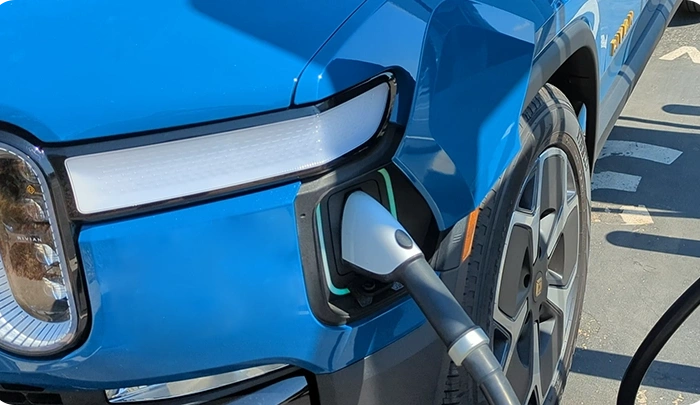
Large boxy vehicles like the Rivian R1S are much less efficient than smaller, flatter EVs.
For example, the Lucid Air has one of the most advanced drivetrain systems, as well as great aerodynamics. Despite its size (195.9 inches long) and weight (over 4,500 lbs), some Lucid Air trims reach a whopping 5.0 mi/kWh. The 2025 Tesla Model 3 RWD is 10 inches shorter and weighs 10% less, yet it achieves an efficiency of 4.1 mi/kWh.
Electric Cars with the Highest mi/kWh Ratings
Here are some of the most efficient electric cars you can buy today:
- 2025 Lucid Air Pure, 5.0 mi/kWh, 420 miles of range
- 2025 Hyundai IONIQ 6 SE, 4.1 mi/kWh, 361 miles of range
- 2025 Tesla Model 3 LR RWD, 4.1 mi/kWh, 363 miles of range
- 2026 Tesla Model Y LR RWD, 4.0 mi/kWh, 357 miles of range
Improving Your EV’s Miles per kWh
There are many ways to get more mileage from the energy stored in your EV’s battery, some of which are no different than a gas-powered vehicle. Here are some tips:
- Electric cars love traveling at low speeds, especially between 30 – 50 mph.
- It’s not unexpected to see mi/kWh jump 25% – 50% when you do so.
- Conversely, fast driving is the enemy of efficiency. At 75 mph or more, your mi/kWh can fall by 10-30%, depending on wind.
- To save energy, take slower roads. Try to avoid fast-moving interstate highways when possible.
- Extreme temperatures, hot and cold, will also significantly reduce an EV’s efficiency.
- On one hand, cold weather won’t harm your battery pack. However, it does make energy transfer less efficient.
- On the other hand, extreme heat can harm your car’s batteries. The car must then use extra energy to maintain ideal pack temperatures.
- Preconditioning your electric car’s battery pack will improve mi/kWh once you get on the road.
- Additionally, using heated seats instead of the main HVAC system can drastically improve your efficiency.
- Your tire choice and inflation level are arguably more important to EV efficiency than with other cars.
- Robust all-season tires may offer great handling. However, anything adding friction with the road will reduce efficiency.
- Make sure your EV’s regenerative braking mode is activated, especially in stop-and-go traffic.
- Regen braking recaptures energy for the battery using magnetic force. It’s much more efficient than relying on mechanical brakes alone.
- Aerodynamics often play a bigger role in EV efficiency than extra weight, especially during highway driving.
- For this reason, I suggest using a tow-hitch carrier for items like bikes or cargo boxes instead of a roof rack.
- On that same note, a trailer that is more aerodynamic and closer to your vehicle’s shape will be more efficient.
Sources