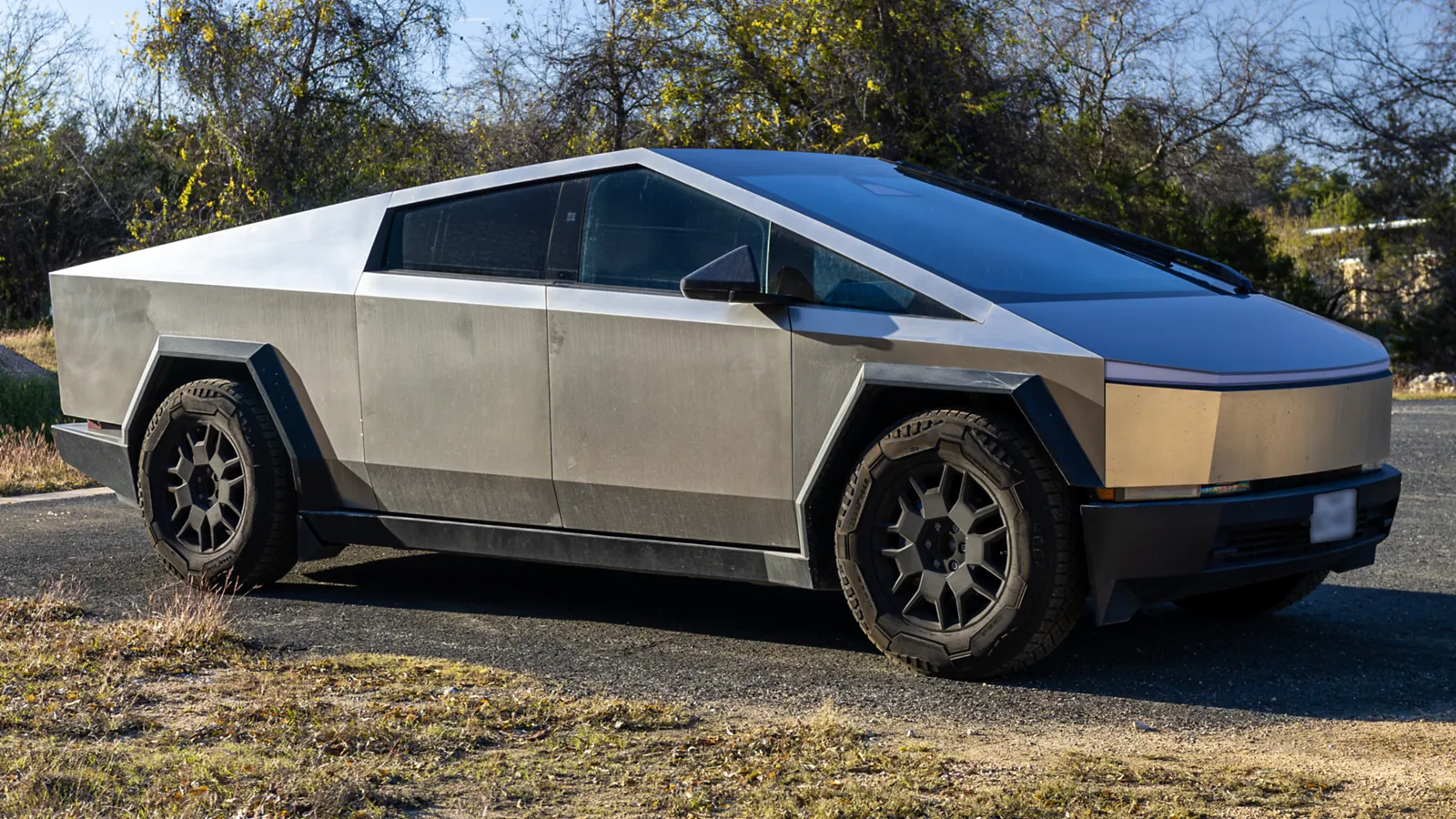

Whether you love or hate the controversial design, the Cybertruck was one of the most surprising vehicles I’ve ever driven. But in a good or bad way?
After spending more than a week with it, here’s what I think you should know.
Fantastic Driving Experience
At first glance, this boxy behemoth looks like it would be a pain to slog around town as a daily driver. But that’s not the reality. In fact, I’d go as far as to say it’s just as easy and enjoyable to drive as my Model Y.
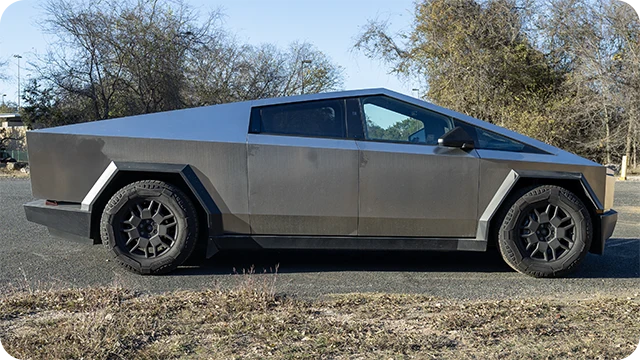
It looks slow and laborious to drive. It’s definitely not.
Why, you ask? It’s not just because the dual-motor model I was hauling around accelerates this beast from 0-60 mph in about 4 seconds. While that’s impressive, there are two more important features: the steer-by-wire system and four-wheel steering.
Steer-By-Wire
Also known as “adaptive steering,” the steer-by-wire system in the Cybertruck changes the amount you have to turn the wheel (or yoke). It does this based on your speed. Long story short, you’ll never be performing hand-over-hand turns.
Four-Wheel Steering
This feature causes all four wheels to twist when you move the steering wheel. It dramatically cuts down on the space needed to maneuver in situations like parallel parking, U-turns, or backing the truck up to attach to a trailer.
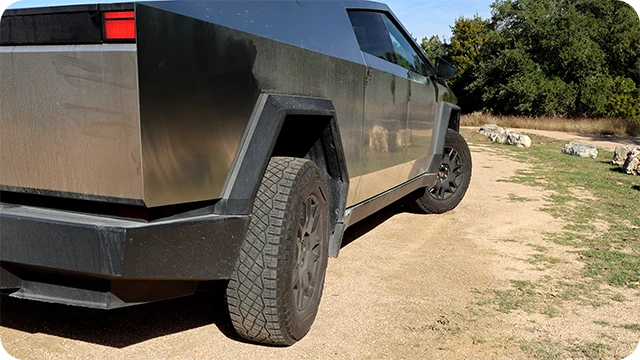
The four-wheel steering system is awesome.
Consider this: it has a 143-inch wheelbase, while the Model Y has a 113-inch wheelbase. Despite being almost three feet longer, the Cybertruck has a turning radius nearly identical to the Model Y’s. You’ll appreciate this steering system every day.
Well-Tuned Suspension
Though the ride height options of the air suspension are pretty standard, it checks the box where it matters most, and that’s comfort. During my time with the truck, I took it over some terrible, crack-filled roads. Despite this, it glided seamlessly like a grand, comfortable cruiser.
Visibility – The Only Downside
The view directly out ahead is clear, even with the deep dashboard that keeps you from seeing the front hood. Elsewhere, visibility isn’t the best. The A-pillars are long and acutely angled, pointing directly in your line of sight in the front corners, more so than in other cars.

The A-pillars can block this corner of your view.
The bigger problem, in my opinion, is that the tonneau cover blocks the view out of the back when it’s closed. The only way to see directly behind you is via the rearview camera feed.

If the sun shines on the rear camera, the feed is basically useless.
That’s not great when you consider this feed is often obscured by weather or dirt/debris. It can even be obscured as a result of the sun shining on it. It’s a compromise Tesla had to make thanks to the overall car design, but one I hope they address in the future.
On the positive side, though, the side view mirrors are larger than on any of Tesla’s other models. There are also built-in blind spot indicators in the door speaker grilles, and you do have front and side cameras to help as well.
Cabin Noise
With tractor-like 20” all-terrain tires, I fully expected the cabin to be loud, in particular at highway speeds. That’s despite it featuring Tesla’s usual wind noise treatments like the laminated glass.
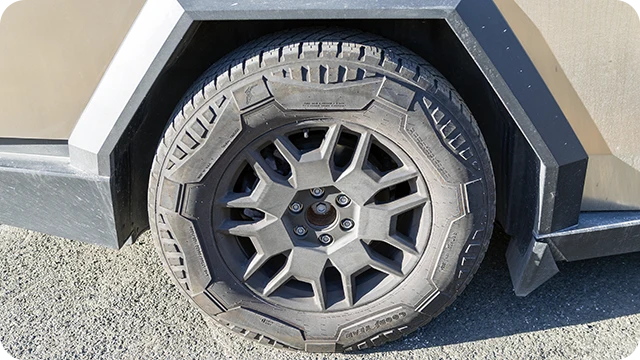
With these massive all-terrain tires, the Cybertruck’s cabin noise could’ve been bad.
I was wrong about that, too. At 55 mph, I measured 67 dB in the cabin. At 75 mph, the reading was consistently showing around 70 dB. To put that into perspective, my Volkswagen ID.4 crossover recorded nearly identical results.
I was genuinely surprised at how well it performed and would not consider this a loud vehicle whatsoever.
Real-World Range
As configured, Tesla’s website claims this dual-motor drivetrain should get around 320 miles of range. But how did it perform in the real world?
After putting 200 miles on it (both in the city and on the highway, with a little bit of heater use at times), the screen was showing the efficiency as being just over 400 Wh/mi. That’s about 5% less than what it claims it’s rated for.
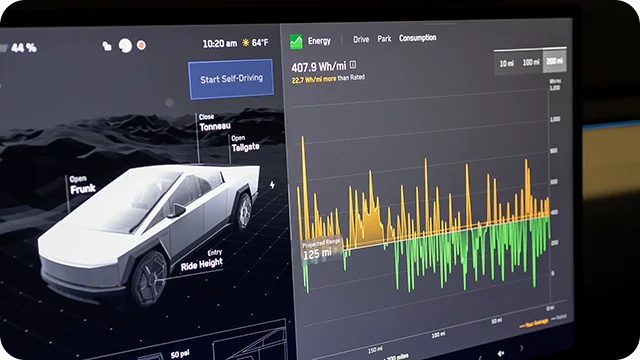
After 200 miles of driving, real-world range was about 285 miles.
Considering the pack has a usable capacity of somewhere around 119-120 kWh, that puts the real-world range close to 285 miles on a full charge. Given the conditions I described, this result was more than satisfactory.
Charging
When it comes to charging, there are two things worth mentioning. First is that it can accept up to 325 kW of charging input, more than any of Tesla’s other consumer vehicles.
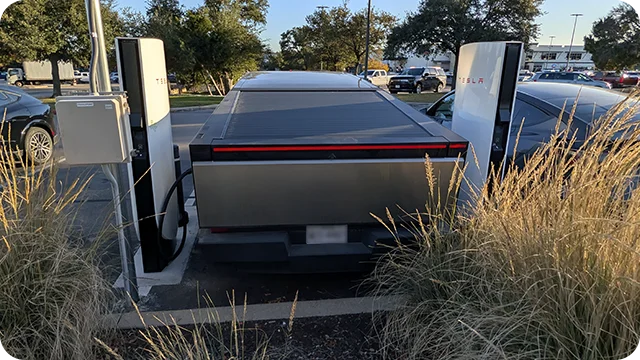
To get the 325 kW charging speeds, you’ll need to use a compatible V4 Tesla Supercharger.
Though I didn’t personally see it reach this level, the curve drops off fairly quickly. So a 10-80% charging session still takes 30-40 minutes total.
Home Charging Note
For home charging, if you are going to buy a large EV like the Cybertruck, you pretty much need Level 2 charging. Otherwise, using a standard 120V wall outlet will net you 1.5 – 2 miles of range per hour.
A Familiar Interior
The cabin itself is very Tesla, just with an angular motif to match the outside. But the various stitched vinyl surfaces and overall design will feel recognizable.

The interior will look familiar if you’ve been inside another Tesla.
It comes with Tactical Gray or White accent options, both with black seats. The truck I had included the white trim, which I usually prefer. If you are going to be doing a lot of truck things, it might get dirty easily. I’d recommend the gray interior instead.

The white interior is gorgeous, but could get dirty quickly.
Worth noting, the dashboard is very deep, extending multiple feet in front of you. White vinyl runs across the lower portion and extends onto the door panels. Ambient lighting strips are built in as well, which can spice things up, if you want.
Front Seats
Headroom and legroom are generous. Taller occupants shouldn’t have any problems, as there’s enough room to stretch out. The front seats are well-formed and as cushy as always. My sciatica approves, even after hours of driving at once. You can heat and cool both front seats, too.

If the front seats keep my lower back happy, that usually means they are properly padded.
Second Row
Like the front, second row seating provides an equally plentiful amount of space for passengers. The seats angle up for better thigh support, and you can heat them, though they aren’t ventilated.
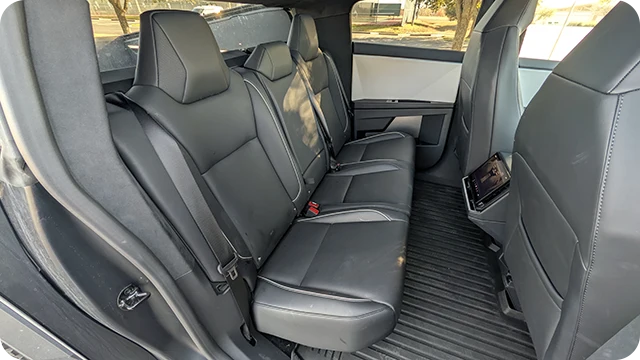
Cybertruck Rear Seats
Center Console
The armrest is quite broad, more than enough for two adults to share. Lift up the padded cover, and you’ll find a deep storage cubby that also contains a 120V outlet, a first for Tesla.
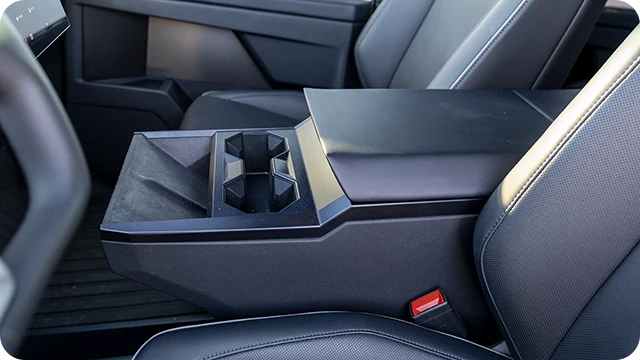
I’m a big fan of large arm rests like this one.
This means you can plug laptops or other electronics in here for substantially faster charging compared to USB-C ports.
As a side note, the pseudo-suede lined wireless phone chargers sit next to the cupholders. If you spill something on them, it will most likely ruin the material. I’d recommend getting a liner (available on Amazon or elsewhere) to cover them.
Other Storage
Below the center console, there’s a wide storage area with raised sides that’s perfect for boxes, small bags, and things of that nature.
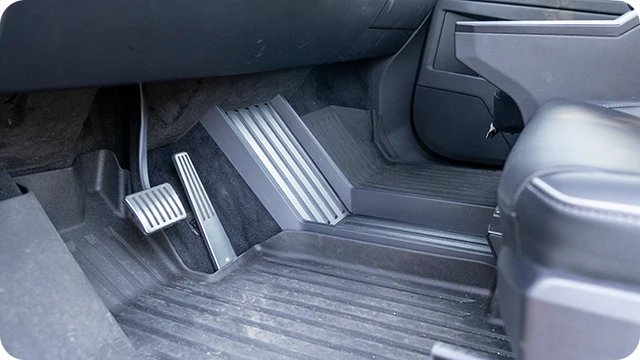
There’s a large storage area on the floor.
The door pockets are also massive and should fit most large bottles as well.
The Steering Wheel (Yoke)
Like everything else in the Cybertruck, the steering wheel or, in this case, yoke has a fancy design as well. It’s angular to match everything else, but what stood out to me is how small it is compared to the surrounding cabin.
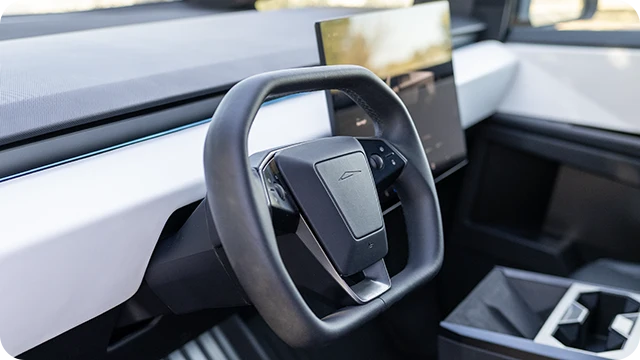
The Cybertruck’s steering wheel (yoke).
The reason for this is the steering and chassis features previously discussed. Thanks to them, you don’t need a larger wheel to control the movements of the tires. Those with smaller hands shouldn’t have problems handling this vehicle.
Since there are no stalks, you control functions like the wipers, lights, etc. through touch-sensitive buttons on the yoke. The gear selector is on the screen like all other new Tesla cars, which I’m not the biggest fan of.
Software & Infotainment
It features a larger 18.5-inch center screen, though it doesn’t have a driver’s display like the Model S and X. The UI is the same as every other Tesla. The difference is a specific Cybertruck skin that changes the look and feel of the buttons and menus to match the car.
The second row comes with a 9.4-inch display. It allows rear passengers to adjust climate, watch apps like Netflix, and connect their devices via Bluetooth.
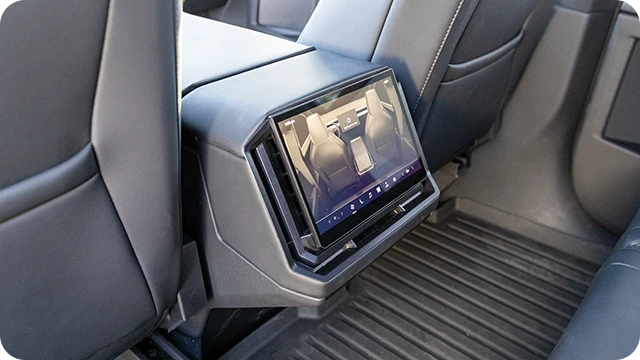
The second row screen.
Other than that, the software is smooth, responsive, and robust, as is the case with every other Tesla.
The Best Sound System in a Truck, Ever?
With two subwoofers and 17 speakers total, the sound system in this truck is hands down one of the best I’ve ever experienced.
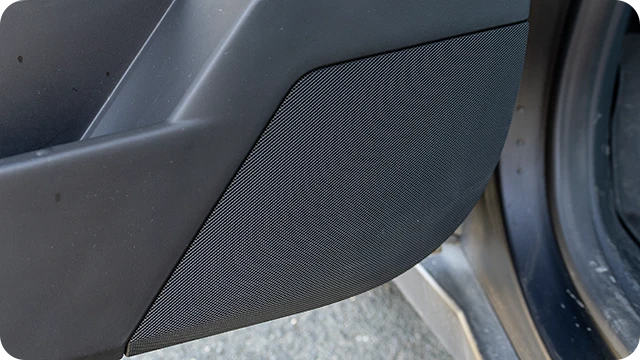
The sound system in this truck is impressive.
The bass response is strong. The separation between instruments and vocals is excellent, and sound flows clearly around the cabin. You’ll enjoy your favorite artists in a brand new way.
Truck Stuff & Cargo
True to its name, the Cybertruck is, in fact, a truck. It has a 6 ft x 4 ft bed in the back, accompanied by some retro-futuristic lights lining both sides.
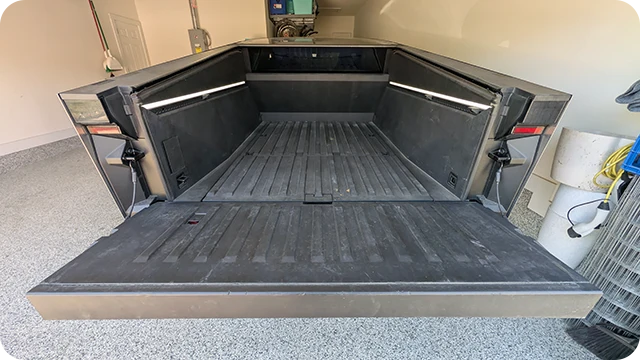
The Cybertruck bed is full sized.
You’ll also find a panel with three outlets: two 120V outlets and a NEMA 14-50 outlet. The NEMA 14-50 outlet provides up to 9.6 kW (40 amps at 240V), and the two 120V outlets supply 20 amps (2.4 kW) each. Total output across all of them is capped at 9.6 kW.
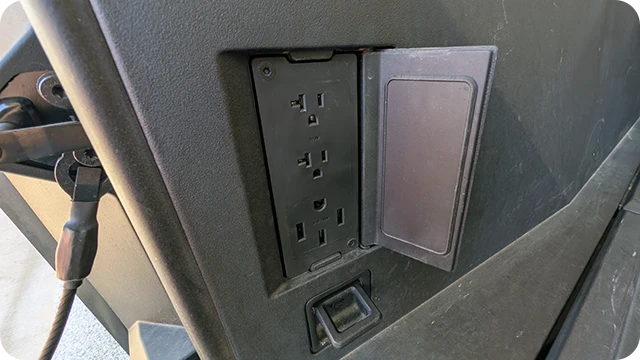
Cybertruck bed outlet panel.
There’s also some extra storage under the bed that includes a drain plug, if you decide to put something liquid down there.
Front Trunk
Perhaps I’m too excited for it, but this is Tesla’s first vehicle to offer an external button for the frunk. It’s such a quality of life upgrade compared to having to fumble around with your phone or the center screen to open it.

It’s smaller than competitor frunks, but still very useful.
One disappointing thing about the frunk is that it’s only 7 cubic feet. That’s half the size of the Ford F-150 Lightning’s. Additionally, there aren’t any standard outlets up here. At the end of the day though, it’s still useful for carrying smaller cargo.
Exterior Quirks
I’m not going to judge the cosmetics of it. You either love the edgy design, or you don’t. But, there are three more practical things I want to mention.

First, opening the doors with a button and grabbing only by the top of the door handle will take getting used to. I usually grab doors by the side, and while it’s not sharp enough to cut you, it’s also not pleasant to touch the bare metal.
As it pertains to the metal, I was wearing sweatpants one day. Every time I opened the door or touched the truck, I got shocked by static electricity. Not exactly fun. To get around this, I’d get it wrapped.
Finally, if you don’t want to spend money on a wrap, the truck always looks dirty. Perhaps, though, that’s the way Tesla meant it to be.
Is It Tesla’s Best Vehicle?
While there are drawbacks, such as the tonneau cover and exterior design quirks, I greatly enjoyed my time with the truck. Much more than I originally expected.
It offers a nice and quiet cabin, an amazing driving experience, has Tesla’s great software, and is very practical. With that in mind, I highly recommend test driving one. You might like it more than you think.
Overall, I’d give the Cybertruck a solid 8.5 out of 10.
Other Tesla Reviews:
Sources
Related Articles